
August 4, 2022
December 10, 2020

November 15, 2020


November 5, 2020


August 19, 2017

July 12, 2017
June 19, 2017
Planetary Discoveries II
NASA finds 10 more planets with the potential for life.
https://www.yahoo.com/news/nasa-telescope-finds-10-more-planets-could-life-163326487.html
https://www.yahoo.com/news/nasa-telescope-finds-10-more-planets-could-life-163326487.html

May 19, 2017

April 14, 2017
FTAs and NAFTA
The history of trade is that two or more parties enter into
agreement to exchange goods or resources exclusively within their respective
territories of negotiated values. It happened the World over as exploration
expanded the reach of humanity. The purpose and usage of the traded resources
was not discussed but was intrinsic to valuations placed upon the resources
exchanged. Also, of importance, is the stage of development of the societal
communities engaged in trade partnership. Industrial developed societies were
trading for raw materials to supply manufacturing while their trading partners
were farmers and tribesmen that thrived from livestock and agriculture. The
result was strip mining of territories for commodities such as precious metals,
oil & gas, gems, etc. in exchange for livestock and developed economy coinage
(money).
Trade balances (surplus and deficit) result from a
multivariate dependence of development levels of trading countries, among other
things. While one country conducts trade in manufactured goods, its partner may
be trading livestock or even the labor of it citizens to manufacture goods with
a lesser expense of capital. The NAFTA agreement is an example of the creation
of a three country trading bloc establishing a North American marketplace where
corporations, to take advantage of the variances, created business strategies
to break up the manufacturing process for a comparatively lower wage labor in
Mexico. The strategy also gets reflected in the Foreign Direct Investment comparisons
between Mexico and the United States and Canada. Politics recognize the foreign
direct investment in Mexico as the United States’ lost opportunity to create
jobs for its citizens. However, no evidence supports the fact that the FDI in
Mexico would take place in the United States absent NAFTA. This leads to the
geopolitics of renegotiating trade agreements for better job creation and
location of the creation.
The Congressional
Research Service published a NAFTA report authored by M. Angeles Villarreal
and Ian F. Fergusson summarizing NAFTA and its impact along with possible
renegotiations. Potential topics include:
Automotive
sector – rules of origin
Services – removal of
barriers to electronic payment card services, electronic signatures, mobile
telecommunications, international roaming rates, and additional market access
in areas such as audiovisual services.
E-Commerce,
Data Flows, and Data Localization – cross-border transfer of
information by electronic means or forced localization of data centers.
Intellectual
Property Rights (IPR) – consideration for expanded provisions related to
widespread use of the Internet on copyright in the digital environment.
State Owned
Enterprises (SOEs)- addressing potential commercial disadvantages to
private sector firms from state supported competitors receiving preferential treatment.
Investment – NAFTA
was the first FTA to contain investor-state dispute settlement (ISDS) provision,
which allows investors to bring arbitration against a host government to
binding arbitration to resolve disputes over alleged violations of a host government’s
investment obligations.
Dispute
Settlement – a binational dispute settlement mechanism to review
anti-dumping (AD) and countervailing duty (CVD) decisions of a domestic
administrative body.
Labor –
strengthening provisions related to the protection of worker rights.
Environment
– hold parties to more enforceable environmental provisions
such as those that require parties to adopt, enforce and not derogate from
their environmental laws to attract trade and investment.
Energy – The United
States may seek greater access to Mexico’s oil sector or to enhance bilateral
cooperation on energy production and security.
Customs and
Trade Facilitation – Discussions could address customs automation
procedures, the creation of a single-access window at one entry point for importers
and exporters.
Sanitary
and Phytosanitary Standards (SPS) – considerations such as
science-based and transparent regulatory activities, including the use of risk analysis
to improve the scientific basis of SPS regulation, notification to importers or
exporters of shipments detained for SPS issues, or consultative mechanisms to
seek quick resolution of such detentions.
As evidenced by the topics and renegotiation summaries, a
major alteration of NAFTA is not likely. What is likely is a tightening of the trading
bloc integration to create a more seamless marketplace similar to the European Union
and the economic political developments of China – Asia.
March 6, 2017
R&D Spending Around the Globe
Organization for Economic Co-operation and
Development (OECD) has a 35
nation membership and provides economic analysis and guidance in an effort to
sustain open democratic governance with a mission to promote policies that will
improve economic and social well-being of people around the world. This
analysis of R&D spending is one of the many reports issued by OECD and
reflects country spending relative to GDP which provides an indicator of future
technological development within society. The associated national wealth is
measured through patents and patent protections for development of the
technological breakthroughs for ownership claims of corporate and industry
developments for expansive application around the world. Included is the use of
military R&D for national defense which can have application within social
technology usage and country business
systems.
The analysis measurement is R&D spending as a percent of
GDP and although other nations may have a higher spending rate than the United
States, the United States still spends more on a dollar basis due to the larger
economy.
"The United States, which spends more than any other country on R&D and accounts for around 40% of total OECD R&D expenditure, saw its R&D intensity rise slightly from 2.76% in 2014 to 2.79% in 2015. Meanwhile, China continued its steady increase in R&D intensity, reaching 2.1% in 2015 – only 0.3 of a percentage point below the OECD average. In volume terms, China’s R&D spending was equivalent to 81% of the United States level in 2015 and 9% higher than that of the EU. The latest patent data show the number of patents filed by Chinese inventors continued to rise in 2014, while filings under the Patent Cooperation Treaty by United States inventors declined."

February 22, 2017
Planetary Discoveries
One tends
to think about planetary governance systems in conjunction with these new
discoveries. The democratic and capitalist society tends to work, but it
has vulnerabilities such as wealth distribution inequalities and certain
discriminatory behaviors impacting quality of life for certain groups. What
really comes to mind is whether the system is duplicable and transferable for
interplanetary governance?
https://www.nasa.gov/press-release/nasa-telescope-reveals-largest-batch-of-earth-size-habitable-zone-planets-around
January 18, 2017
Democracy for Sale
The
implication of the conflicts of interest from the elected - Executive branch
maintaining private sector business interests while politically leading the
country is the United States becoming more alike the non-democratic countries
that the U.S. is trying to influence with Democratic principles of governance.
International politics have shown the regional differences in governance
systems whereby “family” royalty governance models accumulate resource wealth
of a country while their populations struggle in poverty for basic standards of
living. In such cases capital wealth accumulates within a small percentage of
the population that then attempts to protect such wealth through distribution
management. The impact limits the expanse of economic development among the
population necessary for a vibrant social development and tax base to support
public services.
The
attempts to lead the country through the executive branch of government while
maintaining private sector business interests create opportunities for
non-democratic business norms of “pay to play” accusations where payoffs for
favorable policy and regulatory practices to enhance certain industry dynamics
of benefit to “family” oligopolies. In such environments, Capitalism is reduced
to the exchange of financial capital using industry for wealth accumulation as
opposed to constructing social developments. The effect also destroys the
network of sanctions designed to support the building of Democratic norms where
countries' economic resources are used to further “family” royalty wealth in
lieu of building democratic institutions managing society for the betterment of
mankind. At risk is the moral authority used by the United States to protect
mankind for political influence within international affairs otherwise the
Executive Branch of government is viewed as just another oligopolistic business
family directing international politics.
The United
States economy is also at risk in the current environment of international
supply chains supporting American business within a multitude of foreign
countries from the arrangement of international trade agreements. Because many
of these countries lack all of the democratic institutions of governance,
American corporate leaders are negotiating deals with foreign government
entities for development of their countries in exchange for resources included
in the manufacturing supply chain. Disruptions within any part of the supply
chain impacts the availability of goods which impacts corporate earnings which
in turn impacts stock prices which impacts corporate leadership compensation
and tenure. Actions creating the Executive Branch conundrum by acting as
a CEO instead of leader of a Democracy dependent upon the international
recognition of Moral persuasion in international affairs as well as domestic
leadership of government.
December 2, 2016
November 14, 2016
Tech and Television
Much of
the current Silicon Valley M&A activity is the related to the
digitization of Industrial America with social interactivity. The developments
are creating new segments within industry including distribution channels. This
digital segmentation is also creating pricing opportunities in response to
financial earnings pressures and future value. Television is where the
M&A caused disorder is most evitable. Technology has enhanced media
content and digital has created multiple avenues to distribute content against
existing broadcast systems. From traditional broadcast TV to cable TV to
satellite TV to wifi video streaming, digital segmentation is making video
content available for all customer viewing experiences of technology usage: the
desktop PC, laptops, tablets, phones, television, and other mobility devices.
Telecoms
traditionally are primed to focus on digital platform system traffic
categorized as talk, text and data. M&A activity such as Verizon +
Yahoo and AT&T + Direct TV + Time Warner are varied examples of data
strategies of content focus. Verizon targeting social media communications of
video with news, blogging, opinion talk and text. AT&T targeting video
content data usage from satellite TV premium programming of pay TV for internet
technology. Thus, creating channel specific content development based upon
segment pricing for the various blocks of programming such as sports, politics,
news, and the various genres of movie making providing other revenue sources in
addition to the traditional advertising business model.
In
essence, a cable TV and satellite TV distribution strategy using the multitude
of content with pricing strategies to group content and digital channels of
distribution to usage experiences. AT&T’s strategy appears that of a
vertically integrated telecom with TV network capabilities applied to the
digital segmentation created by expanding technology for influence over content
creation. An increasing international demand for American big budget movie
productions (primarily China) will impact segmented distribution strategies by
the sheer volume of a combined American and Chinese audience and distribution
channel economics.
October 10, 2016
Economic Development and Wealth Distribution
Came
across a Bloomberg news article that used the Gini index to measure US
metropolis for wealth distribution. The article ranked the top 10 Most
Unequal US Big Cities based
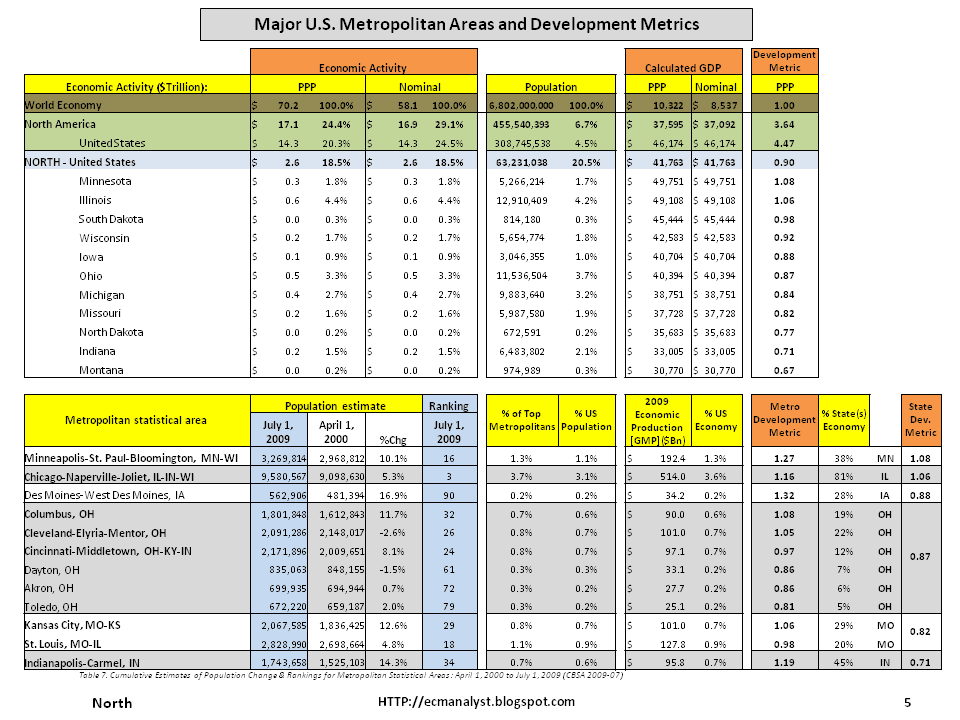
upon the wealth distribution index which reminded me of the ECMAnalyst's
conducted Census evaluation creating the Development Metric index using Percent
US Economy and Percent US Population for the 100 largest US metropolitans. A
different measure of US cities; nonetheless, both are intriguing evaluations of
development. For example, Miami, FL was ranked as the most unequal city in the
US but on the development index it is ranked 55th by development contribution
to the US economy. Concentrations of wealth are likely attributable to basis of
development in leisure, tourism, Latin America gateway, and entertainment.
Neither measurement considers demography of distribution but it is largely
inferred in Gini coefficient indexing. The constructs of the primary industries
for a metropolitan are indicators of predictability for wealth distribution.
The only metropolitans in the top 10 Unequal US Big Cities that
are also top 10 metropolis of the Development Metric are Washington, DC, New
York City, and Boston, MA. It is both alarming and informative with Washington,
DC being the center of U.S. and international politics with economic bases in
legal and government activities setting policy for the country. And New York
City, the largest metro population, adding confirmation to communities feeling
economically "locked out" from the city's and the nation's progress
primarily from decision making within the region's largest industry being
finance (Wall Street) and Boston, MA mutual funds financial services plus
educational services economy components. California has two metrpolitan areas
in the top five of the Development Metric largely due to the computer and
digital technology industry but neither are reflected in the top Gini
coefficient index of wealth distribution of Most Unequal US Big Cities.




September 23, 2016
Politics and Regional Trade


The politics of
regional trade agreements are the attempt to “harmonize” legal framework around
ideals conducive to development while introducing Democratic societal
functions. In a sense, exporting Democracy using corporate economic governance
to open markets accessing capital which accelerates corporate acquisitions
leading to corporate dislocation and employment issues at “home.” Relative to
the basic process of business management, the environment created is one of
Mergers and Acquisition versus Research and Development for growth within
regional territories. Imbalances get reflected in regional areas where
development has historically been concentrated to a specific industry limiting
the ability to rebound from disruption.
Disruption occurs when
regions that have historically been driven by, even dominated by religion
governance ideals meet democracy’s ideal of human individual freedoms as basis
for trade economics. The Morality conundrum. American politics’ overemphasis on
racial relations from the religious perspective of Moral behaviours simply to
protect political
demography leveraging Black | White morality economics. Internationally,
the struggle appears to be regional cultures' emphasis on homogeneity of
religious practices preventing economic development and skepticism of the
American democracy derived from a history of struggles to protect civil rights.
Thus, the basic harmony reflects the best of American ideals and
practices with country region governance where compatible to establish an
acceptable structure to begin economic trade among societies while protecting
already established and developing interests. “Corporate flight” is a
calculated interest of market profitability taking advantage of market openings
and a perspective of equivalence to the American market protections. It is also
the source of initial dislocations at “home” until a new balance is achieved
within employment politics.
August 15, 2016
A Glimpse into the History of "Law" Industry
Intricate
to the American story is the story of industry where "law" is not an
exception to the developments and interrelations called politics. From the
early arrivals looking for wealth in the new Americas as portrayed in the Discovery channel's Real Life Pirates of
the Caribbean documentary to the industrialists looking to expand
territory claims, the "law" and "order" philosophies of the
era have been introduced to this discussion in the Evidentiary Theory blog
posts Part
I and Part
II. Also related is the ideology of managing relationships within a
political frame combining genome science and religion demography found in
the Relativity
Management Theory XX and XY discussion.
The findings are consistent within a system of wealth accumulation
using global regions to play their part in monarchial institutional
developments of planetary resources as a sort of "keepers of the
wealth" relying on the "law" to maintain the parameters of play
within a democratic political system of economic development. The fraternal
nature of "law" industry attempts consistency across institutional
governance of Government, Religon, and Corporation which sometimes gets reduced
to a lowest common denominator. Reflecting wealth protection strategies to
manage financial system concepts of valuation [earnings cash flows, stored
currency wealth, precious material accumulations, & corporate industry
politics]. All of which are displayed in the analysis of the Panama
Papers and related firms implementing the
international transactions.


Subscribe to:
Posts (Atom)